“For even the greatest of deeds, if not haply preserved in written words and handed down to remembrance, become extinguished in the obscurity of silence”
-Preface, The Alexiad
Anna Komnene is one of the first female historians and one of the most valuable primary sources of the Middle Ages. Her written account of her father’s reign, The Alexiad, is our only source of the First Crusade from a Byzantine perspective. This is invaluable to historians even to the present day. In the Byzantine Empire, the role of historian was not typically a title a woman would hold. Byzantine culture was very much a patriarchal society. The ideal woman was to be virtuous, demure, patient, compassionate, and silent. In fact, the ideal state for women in their society was to be in complete seclusion. Naturally, the only women able to achieve this “perfect state” at the time were wealthy and upper-class women. They could afford to remain in seclusion. Yet, unsurprising, women did get involved in the public sphere, but to keep their womanly reputation intact they had to be more creative about the way they went about it. Anna Komnene proved that in her famous history she was an authoritative source and excellent writer, but also acting in the way a noble woman should in society.
The traditional Greek historian was a male-dominated career. The typical subjects of a Greek history consisted of traditionally male-dominated spheres, such as military, politics, and the great deeds of important male leaders. A Greek history was considered quality when the experiences of the author were a key component of the writing. This means that the author needed to write about events that they witnessed or had the connections to interview others who were there. This would be difficult for a woman at this period as she was to be secluded and it would not be proper to speak to men outside of her own family. How would she be a reliable source in the eyes of the readers? A historian would also have to make decisive commentary on the actions of the figures and would interpret the events that took place. This would be too bold for a demure woman. How was Anna able to create her work successfully? As this post continues, we will examine this information. First, a short biography to get to know Anna Komnene.
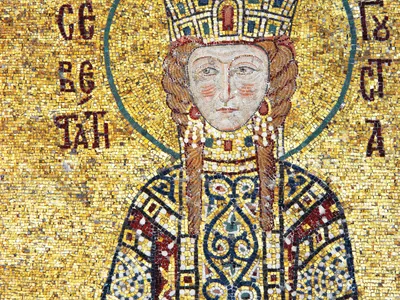
Anna Komnene was “born in the purple” on December 1, 1083, which would give her the privilege to claim the title porphyrogennete. “Born in the purple” was both literal as imperial children were born in the purple room in the Great Palace of Constantinople and figurative as they were the child of an emperor. Anna describes the room herself: “this purple room was a certain building in the palace shaped as a complete square…it looked out upon the sea and harbour where the stone oxen and lions stand. The floor of this room was paved with marbles and the walls were paneled with it, but not with ordinary sorts…but with the marble which the earlier Emperors had carried away from Rome. And this marble is, roughly speaking, purple all over except for spots like white sand sprinkled over it.”
Anna Komnene’s father was Emperor Alexios I and her mother was Eirene Doukaina. She was their first born and would become the eldest sister to nine other children. Anna’s birth was extremely important as she helped to strengthen Alexios’ hold on the empire. Only two years before her birth, Alexios Komnene had seized the throne in a violent coup. The previous emperor, Nicephorus III, was forced to abdicate. There had been much infighting between factions during this period and now that the Komnene dynasty had come to power, Alexios I had to prove that he could bring peace and keep the government stable. It was successful as he would rule for almost four decades.

Shortly after her birth, Anna was betrothed to Constantine Doukas, who was a son of a previous deposed emperor. It was another political tactic to keep the stability during his reign. At age seven, Anna was sent to live with her future mother-in-law, Maria of Alaina. This was typical practice where young girls would be raised by their mothers-in-law to prepare for their future marriage. Maria would be a very influential woman in Anna’s life despite their short time together.
Anna had the example of many strong women in her life, including her grandmother, Anna Dalassene, her mother, Eirene Doukaina, and Maria of Alania. Despite the societal expectations of women, the reality was that there were many who found ways around these restrictions.
Anna writes of her fathers early reign in the Alexiad:
“He really longed that his mother [Anna Dalassene] rather than himself should take the helm of the state…he knew she aimed at the higher life. Therefore, in all daily business he did nothing, not even a trifling thing, without her advice, but made her the recipient and coadjutor of his plans…and made her a partner in the administration of affairs, sometimes too he would say openly that without her brain and judgment the Empire would go to pieces.”
“For my grandmother was so clever in business and so skillful in guiding a State, and setting it in order, that she was capable of not only administering the Romance empire, but any other of all the countries the sun shines upon. She was a woman of wide experience and knew the nature of many things, how each thing began and to what issue it would come…”
It is true that Anna Dalassene did take a large role in the early reign of Alexios I (her son). She was very influential in the coup that brought her son to power through the creation of key political alliances. Her son did appoint her as one of his chief advisors and provided her with the title of Augusta (a title even his wife did not have. Anna Dalassene played a public role government administration and military affairs. She was appointed regent numerous times while her son left on military campaigns. Anna Komnene crafts the story to make it sound like these political aspirations were due to her absolute devotion to her son. Yet, it seems that her grandmother was a highly educated woman in her own right who thrived in a position of power. When portrayed as devotion to her son, Anna Dalassene is still maintaining the virtues of an “ideal woman.” As Alexios I grew older, it seems that he grew resentful and pushed his mother out into a forced retirement to a religious order.
Maria of Alaina was supposed to have been Anna Komnene’s mother-in-law. Shortly after Anna went to live in their household, her fiancée died. During her short stay, Maria ensured that her future daughter-in-law was educated in a variety of subjects such as mathematics, philosophy, medicine, etc. Anna Komnene would develop a great love of learning. As Anna grew up, she would hire tutors of her own to teach her in history, politics, science, astronomy, music, geography, etc. She was very interested in a classical education and loved to read the works of the scholars and epic histories, like the works of Homer.
Anna was clearly talented, intelligent, and ambitious. Her father gave her a leadership role in charge of a hospital where she would teach medicine. She would become an expert on medical remedies for gout, which her father suffered from. It was not typical for women to obtain such a well-rounded education as Anna Komnene did, but she had the support of her grandmother, her parents, and Maria of Alaina who encouraged her work. She also had privileges afforded to her as she was born into the royal family. Privileges aside, Anna Komnene did have the drive to continue to improve herself and the thirst for knowledge that allowed her to accomplish all she did.
“I was not ignorant of letters, for I carried my study of Greek to the highest pitch, and was also not unpractised in rhetoric; I perused the works of Aristotle and the dialogues of Plato carefully, and enriched my mind by the “quaternion” of learning…”
Anna Komnene was eventually married off to Nikephoros Bryennios who was a general in her fathers army. It was another politically advantageous match which would connect two powerful families. They married in 1097 when Anna was fifteen years old. It was a good match as Bryennios also shared Anna Komnene’s love for intellectual pursuits (is this another reason her parents made this match?), and it seems they encouraged each other in these. They both were strong writers. Her husband would go on to write a history of the civil wars of the 1070s (ending with Alexios’ revolt in 1081) that was praised by his contemporaries. Anna had the freedom in her marriage to create and patron a circle of classical scholars where she would participate in debates and intellectual discussions on philosophy and literature.
Anna Komnene does have a black stain upon her glowing record of accomplishments. It is believed that she was involved in a coup/assassination plot against her brother, the future emperor John II, in 1118 shortly after her father’s death. It seems Eirene Doukanina, her mother, preferred that Anna and her husband take on the imperial mantel rather than John. She implied that this was Alexios I’s deathbed wish as well, though he had always favored his son as heir. Anna likely had imperial and political ambitions of her own and now she was offered that opportunity. The coup failed and both mother and daughter were banished by John II into exile at a nunnery. Anna Komnene’s estate was forfeit as well. Due to this, Anna has often been painted by history as ambitious and power hungry (would she have received this negative portrait if she had been born a man?). It is still not known for certain if or how involved Anna was. Most sources believe that she was involved in some clue and her banishment is another key factor. In historian Lenora Neville’s book (Anna Komnene: The Life and Work of A Medieval Historian), she makes the argument that Anna was not involved and has been treated cruelly by history. From the contemporary sources that survive, Neville does not see any evidence or mention that Anna was involved, much of the writing on this event were sources that were written well after 1118. The main source casting Anna as a rebel was Choniates’ account which was written in 1204. This is very far removed from when the events were supposed to have happened.
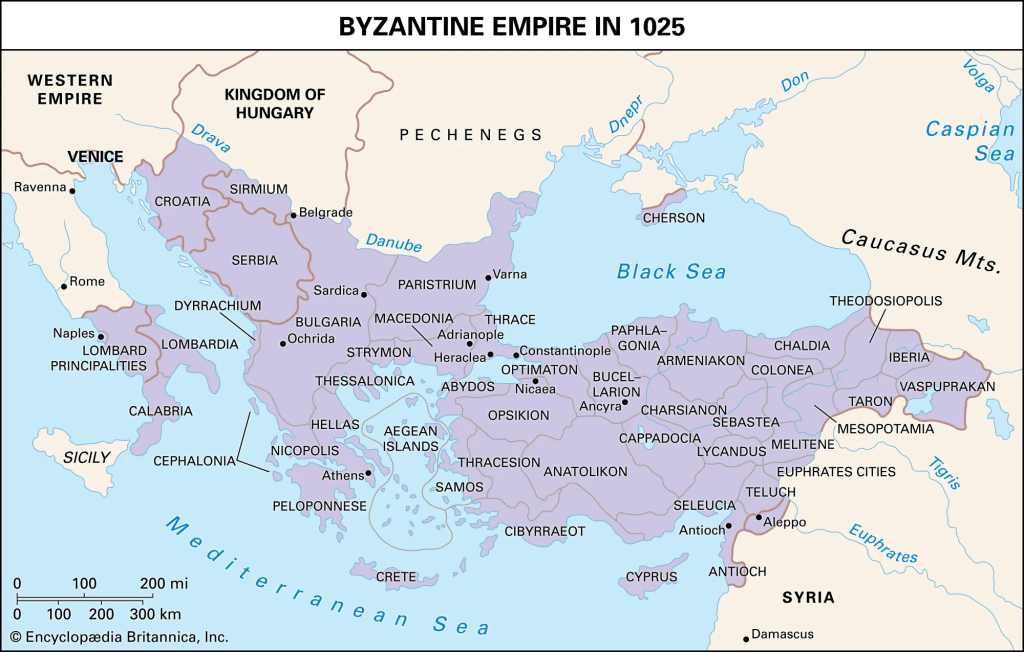
It was during this later portion of her life and during her isolation that Anna Komnene writes her masterpiece, The Alexiad. As stated previously, this becomes a very famous history and remains one of the only contemporary sources we have during the era of the First Crusade. It is especially valued as it comes from the Byzantine perspective.
“I intend in this writing of mine to recount the deeds done by my father for they should certainly not be lost in silence, or swept away, as it were, on the current of time into the sea of forgetfulness, and I shall recount not only his achievements as Emperor, but also the services he rendered to various Emperors before he himself received the sceptre.”
She begins her history where her husband’s writing left off. She takes on the challenge to tell the story of her father’s reign and a bit about her family. Compared to her husband’s work, Anna writes more skillfully and in a more in the classical style. It reads more like an epic tale along the lines of Homer’s Illiad. It is clear she has had much influence from reading the classics. For many of the events, Anna Komnene was present or at least had access to interviewing many of her father’s contemporaries to recount the stories, which include the invasion of the Europeans in the First Crusade.
“He who undertakes the “role” of an historian must sink his personal likes and dislikes, and often award the highest praise to his enemies when their actions demand it, and often, too, blame his nearest relations if their errors require it.”
Despite her phrasing in the quote above, The Alexiad is generally quite a positive portrayal of her father and the Byzantine Empire, so there is bias. She also does not discuss her brother, John II, or the succession at all. This may or may not hint about her feelings regarding the transition after her father’s death.
Anna also paints herself in a certain light as well. As stated earlier, it was not appropriate for a woman to be a historian and a writer. Histories were a man’s domain as they were the only ones who had access to politics, military affairs and it was appropriate to interview men for their perspectives. Yet, if Anna painted herself a certain way, she could get away with it and have her writing be accepted by her contemporaries. She did not write under a false name but displayed hers proudly. Instead, she makes it clear that she is writing from the point of view of a devoted daughter and grieving widow.
“However, I see that I have let my feelings carry me away from my subject, but the mention of my Caesar and my grief for him have instilled devastating sorrow into me. Now I will wipe away my tears and recover myself from my sorrow and continue my task, and thus in the words of the tragedian: ‘I shall have double cause for tears, as a woman who in misfortune remembers former misfortune…’ For to recall him, and make his reign known, will be a subject of lamentation to me, but will also serve to remind others of the loss they have sustained. Now I must begin my father’s history at some definite point, and the best point will be that from which my narrative can be absolutely clear and based on fact…”
In this passage, Anna makes it clear that she is dutifully grieving, but for the sake of the history she is putting aside the emotional side of herself. She is portraying herself as humble and a devoted daughter. All of these are proper traits that a woman is to have in their society, but she has tactfully shown that her writing is for the sake of her devotion and a way to overcome her emotions of grief. All the great female saints and noble women of her era show that they can overcome their emotional nature which allows them to speak and write in a way that is seen as calm and impartial. Essentially, she is accepted “as a man” in this moment.

In conclusion, Anna Komnene is a fascinating medieval woman. As she was born into the imperial family, she did have many privileges that allowed her to pursue her accomplishments. She had a strong thirst for knowledge and was proactive in her education. She studied every subject, which was unusual for women of her age, with a particular interest in medicine and classical history. She had political ambitions and an interest in her father’s reign, but a question lingers of whether she was involved in a political coup to overthrow her brother, John II. Despite being in exile, Anna would go on to write her epic history of the reign of Alexios I, which continues to serve historians to this day.
________________________________________________________________________________________________________________________
I hope everyone enjoyed my post. It feels good to be creating and sharing history again. I have been a bit burnt out, so I took a year off from content creating. I hope to continue writing, though likely more on a quarterly basis. I have some ideas that I would love to have come to life. Stay Tuned!
Sources:
Anna Komnene, The Alexiad, trans. E.R.A. Sewter (Penguin Classics, 2009).
Lenora Neville, Anna Komnene: The Life and Work of A Medieval Historian (New York: Oxford University Press, 2016).
https://www.britannica.com/biography/Irene-Ducas
https://www.britannica.com/biography/Alexius-I-Comnenus
https://www.worldhistory.org/Anna_Komnene/
https://www.britannica.com/biography/Nicephorus-III-Botaneiates
Kelley, Meghan. “The Good Life of Anna Comnena: First Female Historian and Byzantine Princess,” The Histories: Vol. 7 : Iss. 2 , Article 3 https://digitalcommons.lasalle.edu/cgi/viewcontent.cgi?article=1112&context=the_histories
http://www.istanbulkadinmuzesi.org/en/anna_comnena
https://www.thoughtco.com/anna-comnena-facts-3529667
First Crusade (5 part series). History Extra Podcast, podcast audio. Oct 2023.

 Travel Through Time
Welcome back! Look forward to your future blogs!
LikeLike